
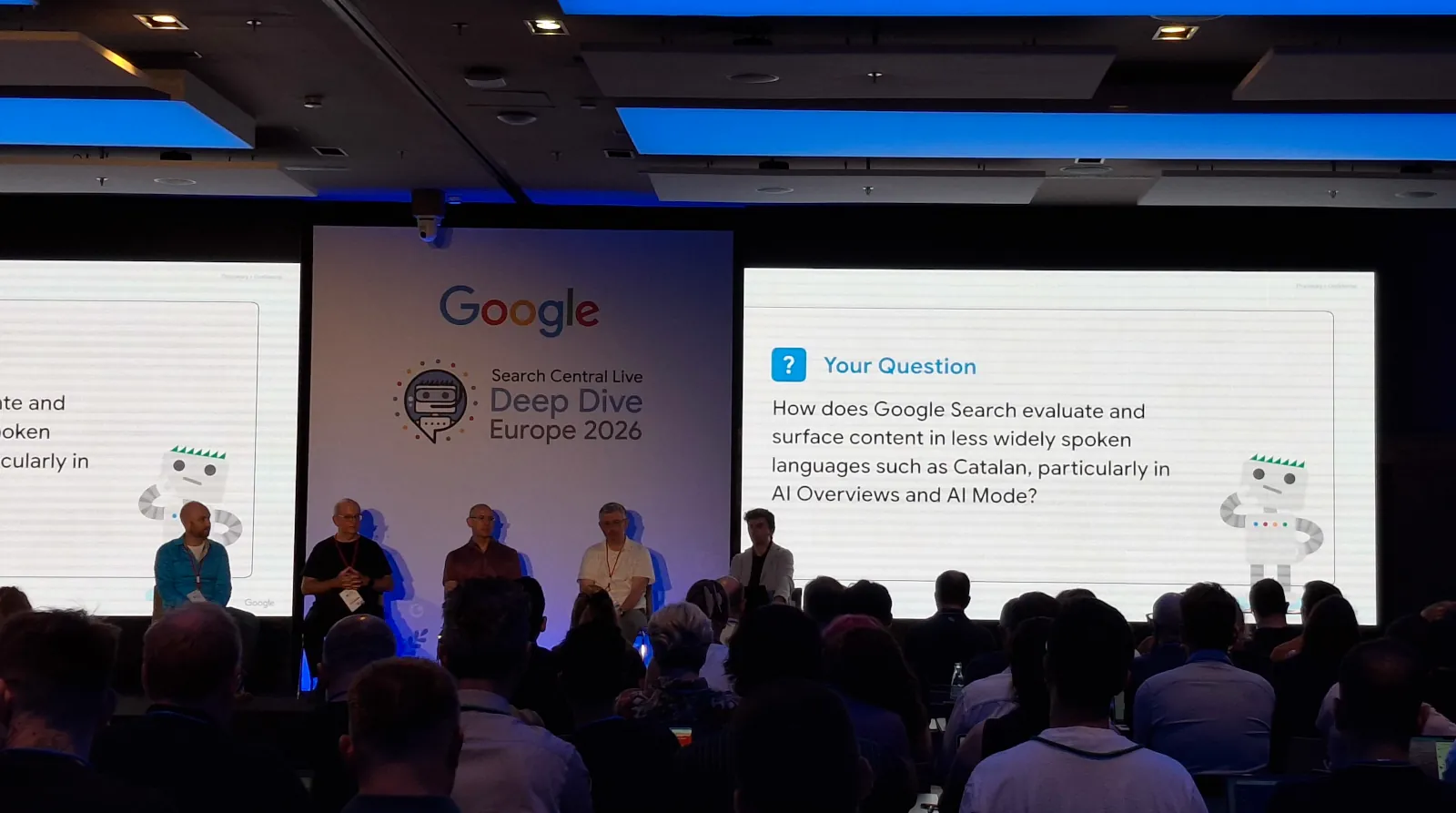
From 30 September to 2 October, Barcelona hosted Google Search Central Live Deep Dive Europe 2026. I heard directly from the Google team about how the search engine discovers pages, reads them and decides which to include in its index.
Comparing approaches with the Google team and exploring other professionals’ case studies helps clear up doubts, particularly as artificial intelligence changes how we search for information.
If you run a business and want customers to find you, these are the ideas I am taking back to the websites I work on.
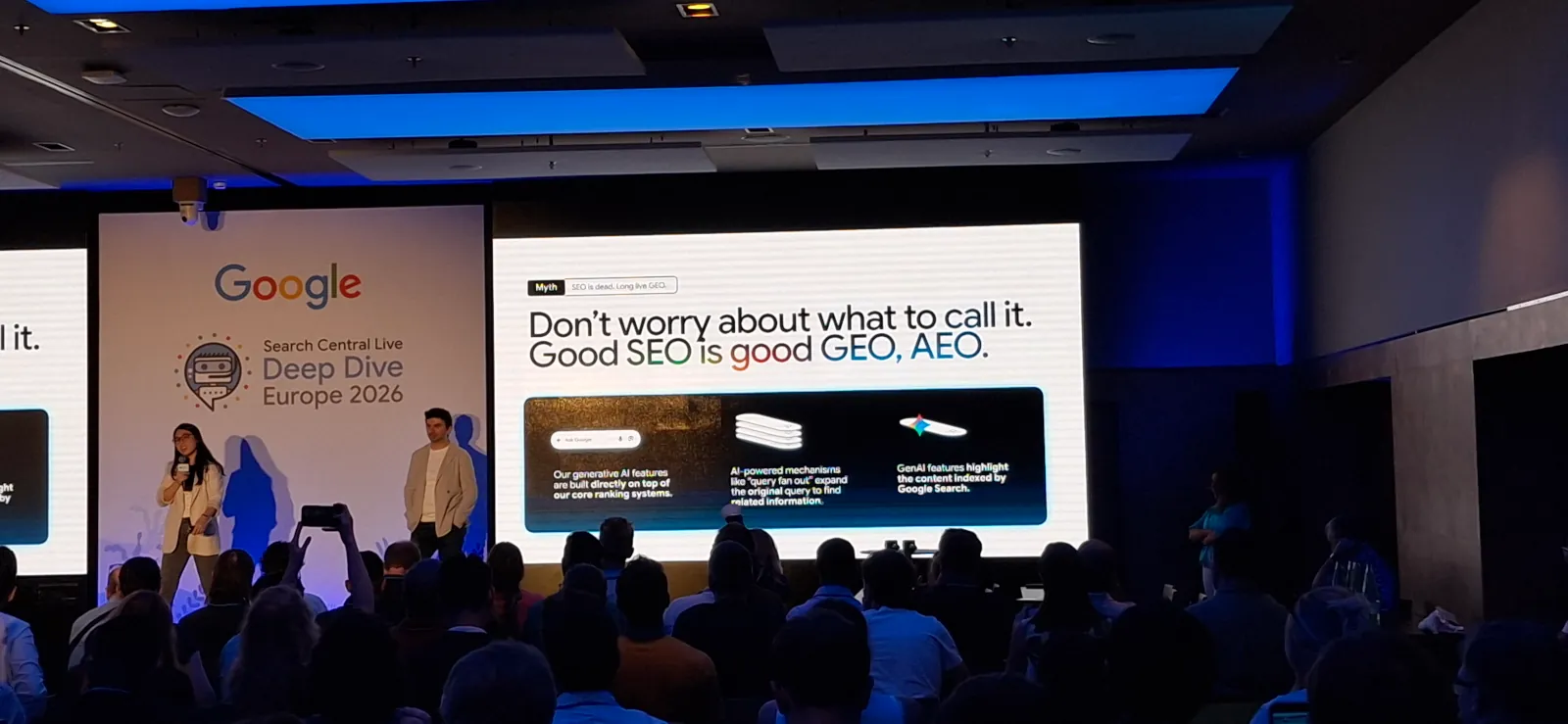
Gary Illyes and Cherry Prommawin from the Google Search team at Deep Dive Europe 2026: ‘Good SEO is good GEO, AEO’. SEO fundamentals remain relevant to the search engine’s AI answers.
1. First, Google must be able to read your website
Systems that speed up and protect a website, such as a CDN, firewall or anti-bot tool, need to be configured so they do not block Googlebot, Google’s crawler. The server also needs to respond without errors: if it is slow or frequently fails, Google may reduce how often it visits the pages.
Content loading also needs reviewing. Google can execute JavaScript, but if text only loads after a visitor clicks or interacts with the page, Google may not be able to read it. A collapsed section with text already loaded is different: the content may be accessible to Google even if it is initially hidden from view.
2. AI does not replace SEO: it builds on it
Google’s message was clear: AI answers in search, such as AI Overviews and AI Mode, build on existing search systems and use content from the index. Googlebot remains the crawler that visits pages.
For a page to appear as a source in these answers, it first needs to be indexed and eligible to appear in search. SEO fundamentals remain relevant: an accessible, well-structured website with useful content. There is no need to create a special version ‘for AI’.

According to Google, AI Mode queries have doubled each quarter since launch and are, on average, about three times longer than traditional searches. To use a local example: people are not simply searching for ‘plumber Terrassa’, but asking complete, nuanced questions.
3. Publishing does not mean appearing on Google
One recurring point was that Google’s index does not store everything.
If you have many near-identical pages, such as service pages where only the town name changes, Google may group them as duplicates and choose one as the main version. Each page should offer a specific benefit to the visitor.
On the second day, a case study described a business that merged two websites and reduced 2,000 pages to 100 without losing traffic, while increasing revenue. I thought it was a useful example of concentrating information into well-developed, useful pages.
4. Key information belongs in the main content
The main content explains your services, products and what is useful to the visitor. Essential information — what you offer, where you work or what makes you different — belongs high up in the page body, rather than hidden in the footer or sidebar.
This is also about clarity for visitors: they should quickly understand whether you can help them.
5. Translating a website is not the same as adapting it
For multilingual websites, adapting the offer to the market matters as much as translation. One speaker described a furniture business that sold far less in the Netherlands than in France despite an accurate translation. Its furniture and photographs did not fit the size and layout of Dutch homes, which were narrower and spread over several floors.
You need to check whether products, examples and images make sense for the intended audience.
There was also an opportunity closer to home: Gary Illyes explained that Google is more permissive with indexing in languages with less content, using Basque as an example. This made me think of Catalan: many local sectors also have little useful Catalan content, and publishing quality material is an opportunity to reach customers searching in that language.
My accreditation for Deep Dive Europe 2026.
What can you check on your website today?
- Can Google access the important pages without being blocked?
- Does the server respond without errors and within a reasonable time?
- Does important content load without depending on visitor interaction?
- Do you clearly explain what you offer, where you work and what makes you different?
- Does each page provide useful information, or largely repeat the others?
- If the website has several languages, is each version adapted to its audience?
For a business, the message is practical: make it easy for Google to read the website and for customers to find useful answers.
My thanks also to Gary Illyes for his availability and for replying to my email, even late at night.
If you would like to know how your website measures up on these points, let’s discuss it and arrange a review.